Sep 19, 2025
Why Personas Are the Missing Ingredient in Enterprise AI
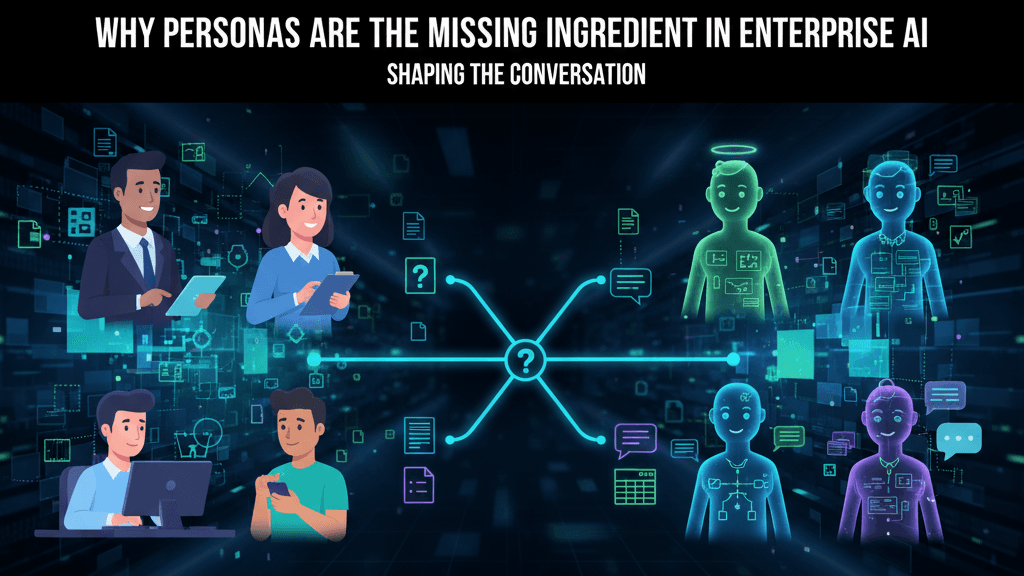
When most companies talk about AI, the conversation centers on models and data. Which LLM should we use? How should we prepare documents? Do we need fine-tuning?
These are critical questions. But there’s another dimension that often gets overlooked — one that determines whether your AI is just “accurate,” or whether it actually feels useful, trusted, and human.
That dimension is Personas.
What Do We Mean by Personas?
In everyday language, a persona is a profile of a type of user. In enterprise AI, we take that further. A persona isn’t just about who is asking the question — it’s about shaping the entire conversation.
At CompanyInsights.AI, a persona encodes:
The role of the user: broker, care coordinator, plan designer, customer, executive.
The role of the AI: explainer, analyst, advisor, guide.
The corpus: what knowledge base the system should be drawing from.
The intended language & structure: concise or detailed, formal or conversational, text or tabular output.
The result is that the same question — “What does this plan cover for imaging?” — can produce radically different but equally correct answers depending on the persona.
An Example in Action
Imagine three different users ask the same question:
Broker persona:
“The Gold PPO plan covers advanced imaging like CT and MRI after a $500 deductible, then a 20% coinsurance.”
Care coordinator persona:
“For your patient, CT and MRI are covered once the $500 deductible is met. After that, the plan pays 80% and the patient pays 20%.”
Executive persona:
“In the Gold PPO, advanced imaging is covered subject to a $500 deductible and 20% coinsurance. Imaging utilization is in line with peer benchmarks.”
Each answer is correct. But each is tuned to the audience. That’s the difference between “accurate AI” and “trusted AI.”
Why Personas Matter More Than Ever
Fine-tuning has often been used to make models “sound right” — to give them a consistent voice in a particular domain. But it bakes tone into weights, which can’t flex when the audience changes.
RAG with personas solves this:
Flexibility: adjust style and depth per role without retraining.
Adoption: users trust AI more when it speaks their language.
Compliance: role-specific instructions help ensure regulated outputs stay aligned.
With personas, RAG doesn’t just recall facts. It delivers them in the right way for the right person, every time.
Closing the Loop
We’ve already seen how RAG can outperform fine-tuning on accuracy and freshness. Personas add the human layer that makes AI actually stick in the enterprise.
In other words:
AI-ready data makes the model smart.
Query expansion makes the model effective.
Personas make the model trusted.
And trust is the missing ingredient in most enterprise AI strategies.
The Bottom Line
If your enterprise AI sounds the same to everyone, you’re not leveraging its full potential.
AI doesn’t just need data. It needs perspective. Personas aren’t just a layer on top of enterprise AI — they are the bridge between raw intelligence and real adoption. Without them, AI risks being accurate but ignored. With them, it becomes trusted, actionable, and human.
At CompanyInsights.AI, we’re showing enterprises every day how personas transform AI from a tool into a partner.
If you’re ready to see it in action, I’d be glad to help. I guide enterprises on adopting generative AI in ways that are both effective and compliant. You can connect with me directly (David Norris) for a free consultation — or even Book a Same Day Demo. Let’s put your documents to work.
More blog

See CompanyInsights.AI on your data
Schedule a live demo and we’ll show you how Agentic RAG + Personas work with your policies, contracts, and internal docs.