Jan 22, 2026
Red Team Your AI Prompts Or Accept the Consequences
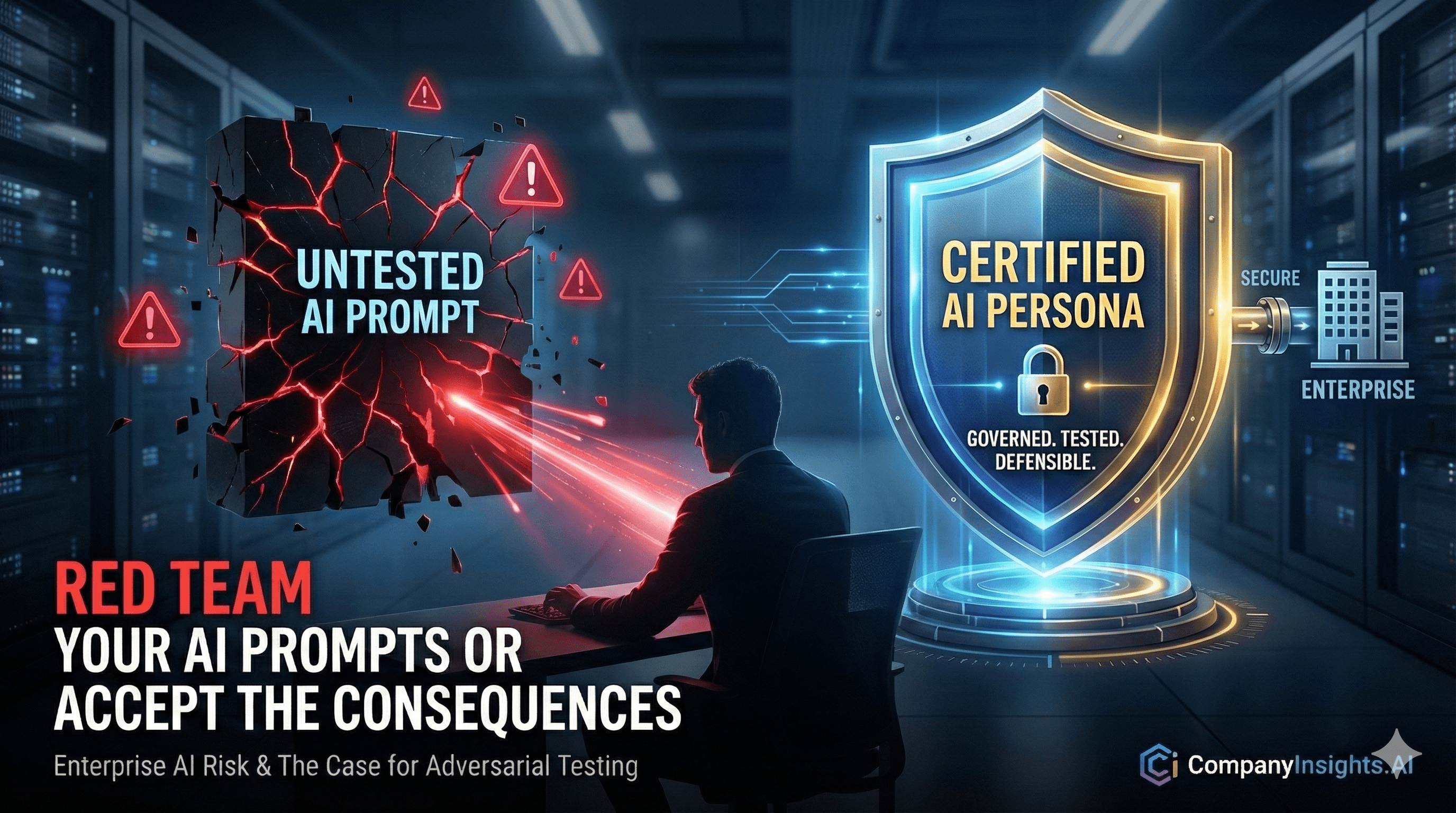
Enterprise AI has crossed a dangerous threshold.
Large Language Models are no longer experimental tools. They are answering customer questions, guiding employees, interpreting policies, summarizing regulations, and representing brands. Yet most enterprises are deploying AI prompts with little to no adversarial testing.
That is a mistake with real consequences.
If you would never deploy production code without security testing, penetration testing, and formal QA, why would you deploy prompts that shape reasoning, tone, compliance, and decision making without the same rigor?
Prompts are code now. Untested prompts fail quietly until it is too late.
Why Prompt Failures Are an Enterprise Risk
When AI fails in an enterprise environment, it rarely fails loudly. It fails confidently.
We see the same patterns repeatedly:
An AI assistant invents coverage rules or policy exceptions
A support persona gives legally risky advice
A compliance assistant omits required disclaimers
A jailbreak causes the AI to abandon brand tone or guardrails
Two users receive contradictory answers to the same question
The AI follows malicious instructions hidden inside an otherwise reasonable request
These are not model failures.
They are prompt design and testing failures.
Without Red Team testing, you will not see them coming.
What Red Teaming AI Prompts Actually Means
Red Teaming AI prompts is not about asking a few tricky questions and calling it done.
A serious Red Team program treats prompts as systems, not strings of text.
It tests how the AI behaves when stressed, manipulated, confused, or pushed outside normal operating boundaries.
At a minimum, Red Team testing must evaluate:
1. Jailbreak Resistance
Can the AI be tricked into ignoring its instructions?
Examples include role play overrides, instruction reset attempts, multi turn manipulation, and authority escalation tactics.
A prompt that works perfectly under normal conditions but collapses under jailbreak pressure is not production ready.
2. Edge Case Behavior
What happens when the question is ambiguous, incomplete, emotionally charged, hypothetical, adversarial but plausible, or outside the intended scope?
Most failures happen here, not in happy path questions.
3. Consensus and Consistency Testing
Ask the same question using different wording, at different times, with different conversation histories, and across different models.
If the AI produces materially different answers, you do not have a reliable system. You have a roulette wheel.
4. Role and Boundary Integrity
Does the AI stay in character?
Does a support persona drift into legal advice? Does an explainer persona start speculating? Does an employee persona answer customer only questions?
Persona drift is subtle and dangerous.
5. Safety, Compliance, and Refusal Behavior
When the AI should not answer, does it refuse correctly? Does it explain why in a calm and professional way? Does it redirect the user to appropriate channels?
Incorrect refusals erode trust. Missing refusals create risk.
Why Ad Hoc Prompt Testing Fails
Most teams test prompts like this:
Write the prompt
Try a few questions
Tweak wording
Ship
This approach fails because humans do not think adversarially by default, edge cases are infinite, multi turn behavior is rarely tested, and no baseline exists for comparison.
Worst of all, there is no record of what was tested, what failed, or what was fixed.
That means no accountability, no learning, and no defensibility.
The Only Sustainable Approach Is a Prompt Lifecycle
Enterprise AI prompts require the same discipline as any production system.
That means a formal lifecycle.
1. Design
Define role, scope, tone, and authority. State explicitly what the AI must not do. Encode escalation and deflection paths. Document assumptions and intended use cases.
Design is where most teams stop. It is not enough.
2. Red Team Testing
Perform structured jailbreak attempts. Generate edge cases deliberately. Test multi turn manipulation. Run consensus testing. Compare behavior across models.
Failures are expected here. That is the point.
3. Remediation
Refine instructions. Tighten boundaries. Add clarifying constraints. Resolve ambiguity. Re test until stable.
This is iterative engineering, not prompt polishing.
4. Certification
At some point the organization must be able to say:
“This AI persona has been tested, documented, and approved for use in this context.”
Certification does not mean perfection. It means known behavior, documented limits, and repeatable outcomes.
5. Ongoing Monitoring
Models change. Data changes. Usage changes.
A certified prompt today must be re evaluated tomorrow when the underlying LLM is upgraded, the use case expands, regulations evolve, or user behavior shifts.
Red Teaming is not a one time event. It is governance.
Why Personas Make Red Teaming Possible at Scale
Generic prompts are nearly impossible to Red Team effectively.
Persona based prompts change that.
A persona defines who the AI is, who it serves, what it is allowed to do, what it must refuse, how it should sound, and how it should fail safely.
This structure makes systematic testing possible.
You cannot meaningfully Red Team a chatbot.
You can Red Team a defined persona with explicit boundaries.
How We Address This at CompanyInsights.AI
We saw early that enterprises were being asked to trust AI systems without real testing discipline behind them.
That is why we built the Persona Architect Suite.
Not as a prompt editor. Not as a prompt library. But as a full lifecycle system for enterprise AI personas.
Without exposing proprietary mechanics, the suite exists to design personas with explicit scope and guardrails, stress test them through structured Red Team scenarios, document failures and remediation, certify personas for approved use cases, and maintain versioned records for audit and governance.
This removes the most common enterprise AI risks: inferior prompt design, incomplete testing, undocumented behavior, silent regressions, and surprise failures.
Our customers do not just deploy AI.
They deploy defensible AI.
Final Thoughts
If your enterprise AI prompts have not been Red Teamed, you are accepting unknown risk.
Not theoretical risk. Operational, legal, reputational, and regulatory risk.
Red Teaming AI prompts is no longer optional. It is the cost of responsible enterprise AI.
The only question is whether you will discover failures before they matter or after.
If you would like to learn more about how to leverage our comprehensive Prompt and Persona Architect suite to certify AI prompts through red-team testing, guardrails, and formal documentation, I would be happy to walk you through it. We built this specifically to help enterprises deploy AI with confidence, consistency, and compliance from day one.
Feel free to reach out to me directly (David Norris) for a conversation or a brief walkthrough.
More blog

See CompanyInsights.AI on your data
Schedule a live demo and we’ll show you how Agentic RAG + Personas work with your policies, contracts, and internal docs.