Feb 9, 2026
How Steve Jobs Would Pitch AI Today
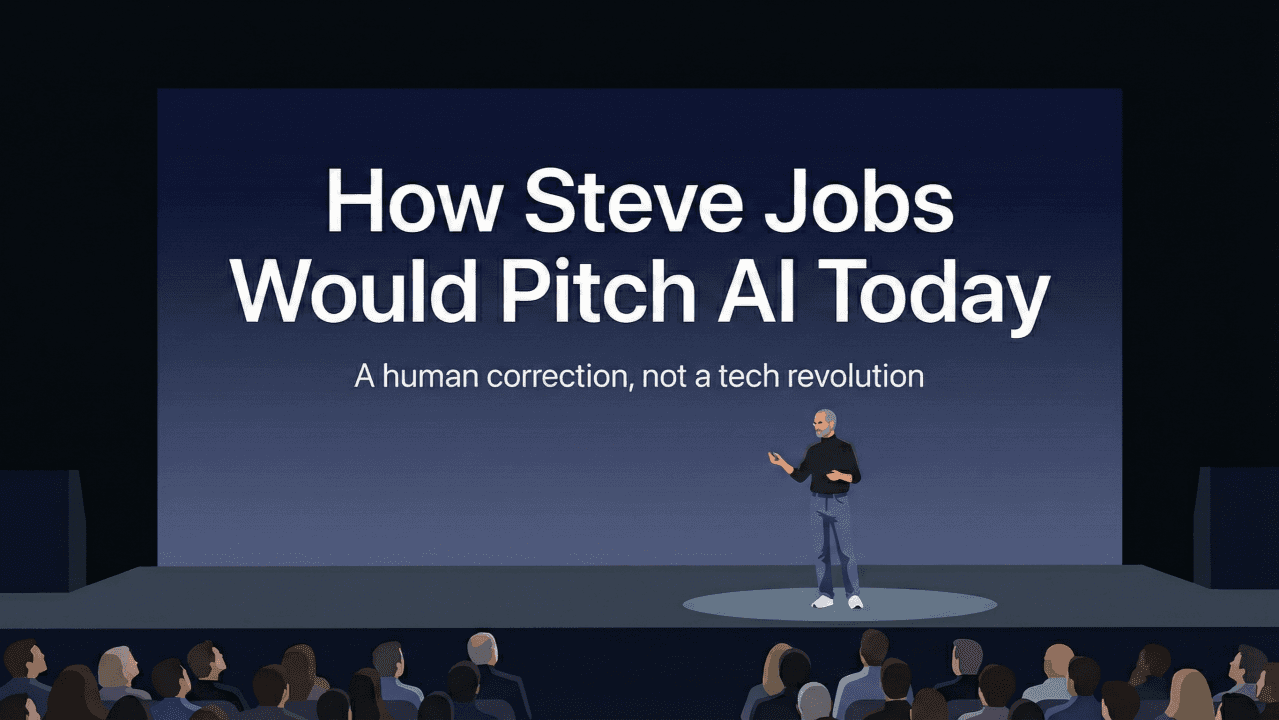
I was recently writing an internal memo on pitch discipline for our AI products. The goal was simple: explain why our training sessions and sales demos need a single, clear voice and one coherent narrative. As I was writing it, I found myself thinking back to the early days of Apple and the way Steve Jobs introduced entirely new categories of technology with an almost ruthless clarity.
Over the years, I spent a lot of time watching those early Apple keynotes, reading books, interviews, and long-form articles about Jobs, and studying how Apple framed unfamiliar ideas so they felt inevitable rather than intimidating. That perspective came back to me while thinking about how AI is being introduced today, and how much of what made those moments work is missing from modern AI pitches.
That’s when the question clicked.
How would Steve Jobs pitch AI today?
Not how would he build it. Not how would he market it at scale. But how would he stand on a stage, or sit across a table, and introduce AI to an audience that is excited, confused, skeptical, and quietly worried about what it means for their jobs, their companies, and their future.
As a quick aside, and with some humor, I don’t believe Apple would be trailing in the AI conversation if Jobs were still driving the wheel. But that’s a different article. For this one, let’s assume Apple has world-class AI products. The interesting question is how Jobs would explain them to humans.
History gives us more than enough clues.
Jobs Never Led With Technology. He Led With Tension.
One of the biggest mistakes companies make when pitching AI is starting with the technology. Models, parameters, architectures, benchmarks, roadmaps. Jobs almost never did that.
He started with tension.
“This is a phone.”
“This is an iPod.”
“This is a thousand songs in your pocket.”
He didn’t begin by explaining how it worked. He began by framing a frustration the audience already felt but hadn’t fully articulated.
If Jobs were pitching AI today, he would not open with large language models or neural networks. He would open with something closer to:
“We all spend too much time searching for answers in systems that were never designed to help us think.”
AI, in his hands, would be positioned as a response to human friction, not a breakthrough in machine intelligence.
He Would Make AI Feel Inevitable, Not Impressive
Jobs understood something most technologists miss: people don’t adopt what impresses them; they adopt what feels inevitable.
Every great Jobs pitch had a quiet subtext: “Of course this is how it should work. Why didn’t it always?”
If he were pitching AI, he would not try to convince people that AI is powerful. He would make it feel obvious.
He would likely frame AI not as “artificial intelligence” at all, but as the next step in the long arc of human-computer interaction:
command lines
graphical interfaces
touch
voice
intent
AI would be positioned as the computer finally understanding what you are trying to do, instead of forcing you to explain it in its language.
That framing reduces fear. Fear comes from mystery. Inevitability comes from continuity.
Jobs Would Ruthlessly Control the Message
This is where pitch discipline comes in.
Jobs believed clarity was fragile. He treated it like a scarce resource that could be destroyed by one careless slide or one unnecessary explanation. That’s why Apple launches under Jobs had:
one narrator
one story
no panel discussions
no drive-by commentary
If AI were on the line, that discipline would be even tighter.
AI triggers anxiety. Anxiety makes people hyper-sensitive to inconsistency. Multiple voices, multiple framings, or last-minute “helpful additions” would be viewed by Jobs as message pollution.
If something mattered, it would be in the story. If it wasn’t in the story, it wouldn’t be said.
He Would Hide the Complexity On Purpose
Jobs did not simplify because the technology was simple. He simplified because people need emotional safety before they can absorb complexity.
Under the hood, Apple products were often brutally complex. On the surface, they felt calm.
AI is the same. Jobs would never expose model internals or system diagrams in a first pitch. He would show outcomes.
“Here’s a question.” “Here’s what happens.” “Here’s why your life is better now.”
Only later, when trust was established, would depth be allowed. Complexity is earned. It is not front-loaded.
Jobs Would Reframe AI as a Tool for Humans, Not a Replacement
One of the most damaging narratives around AI is that it replaces people. Jobs hated narratives that diminished human agency.
He didn’t sell computers as replacements for humans. He sold them as bicycles for the mind.
AI, in his framing, would not replace thinking. It would remove friction around thinking. It would handle the tedious parts so humans could do the meaningful parts.
He would likely position AI as:
an amplifier
a guide
an assistant
a collaborator
Never as an authority. Never as an oracle.
He Would Design the Pitch Like a Product
Jobs treated pitches the same way he treated products:
designed
rehearsed
stripped of excess
emotionally intentional
Every transition would matter. Every pause would matter. The ending would be as important as the beginning.
Especially with AI, the ending matters.
People walk out remembering how they felt. If they leave feeling overwhelmed, threatened, or confused, adoption stalls. If they leave feeling calm, confident, and curious, momentum builds.
Jobs knew this instinctively.
The Core Lesson
Steve Jobs would not pitch AI as a technological revolution.
He would pitch it as a human correction.
He would:
lead with human problems
make AI feel inevitable
enforce ruthless message discipline
hide complexity until trust was earned
frame AI as empowering, not replacing
and deliver it all through one clear, confident voice
That’s not nostalgia. That’s pattern recognition.
And if we are serious about introducing AI into real businesses, with real people, carrying real risk, those patterns matter more than ever.
If you’re thinking about how to introduce AI to your organization in a way people actually trust, adopt, and use, this is exactly the problem space I work in.
I help leadership teams design and deploy enterprise AI that is disciplined in its messaging, governed in its architecture, and grounded in real human workflows, not hype or fear.
If a thoughtful, Jobs-level approach to pitching and rolling out AI resonates with you, feel free to connect with me directly, David Norris. I’m always happy to have an open conversation or offer a free consultation.
More blog



See CompanyInsights.AI on your data
Schedule a live demo and we’ll show you how Agentic RAG + Personas work with your policies, contracts, and internal docs.