Jan 13, 2026
The SaaS Collapse Order
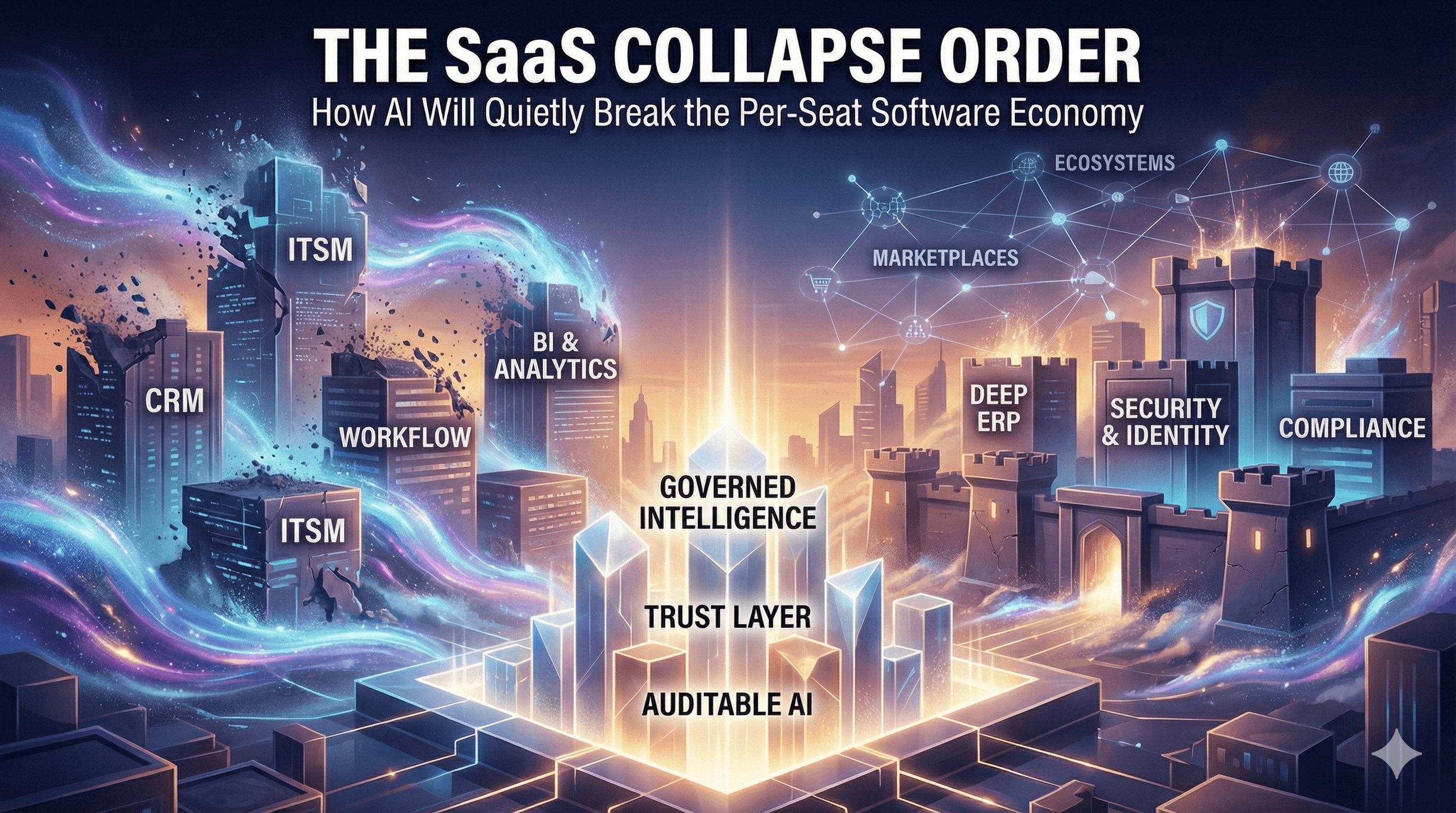
How AI Will Quietly Break the Per-Seat Software Economy, and the Ecosystems Built on Top of It
There is a sentence forming quietly inside enterprise IT organizations that would have been unthinkable just a few years ago:
“Why are we still paying per-user licenses for this?”
Not because budgets are tight. Not because vendors stopped innovating. But because software itself is no longer scarce.
AI is transforming software from a product you buy into a capability you generate.
When that shift completes, SaaS doesn’t explode — it erodes. Slowly. Quietly. In a predictable order.
The real question isn’t whether AI can build enterprise software. It’s this:
What happens to companies like Salesforce or ServiceNow when their customers realize they can manufacture exactly what they need without per-seat licenses, marketplaces, or armies of consultants?
The answers are not intuitive, and they don’t favor the companies most people expect.
This article maps the SaaS collapse order and explains which platforms lose relevance first, which survive longer, and why the greatest damage won’t be to products, but to the ecosystems built around them.
The Rule That Explains Everything
Before naming companies, there is one rule that governs what happens next:
The closer a SaaS product is to “workflow convenience,” the faster it collapses. The closer it is to “risk, trust, or law,” the longer it survives.
AI destroys convenience first. It struggles with trust last.
With that rule in mind, here is the collapse order.
Tier 1: First to Crack (Already Underway)
These platforms are not bad products. They are simply structurally exposed.
1. Internal Tools & CRUD Platforms
Platforms users recognize instantly:
Retool
Bubble
Mendix
Microsoft Power Apps
These tools exist to make it easier for humans to build internal applications.
AI removes the human bottleneck.
When an enterprise can use AI to generate APIs, data models, UI layouts, and tests, the value of paying a subscription for scaffolding collapses.
This category doesn’t implode. It erodes, quietly, through non-renewals and internal builds.
2. Departmental Workflow & Work Management SaaS
Common platforms embedded across teams:
Airtable
Smartsheet
Asana
Monday.com
These tools exist because humans need help coordinating work.
AI doesn’t coordinate work. It executes it.
Once AI agents decide what needs to happen next, what’s blocked, who needs attention, and what’s at risk, the board or table UI becomes optional.
Seats quietly disappear.
3. Core CRM (Sales & Customer Operations)
This is where the conversation gets uncomfortable.
Platforms nearly every sales organization knows:
Salesforce (Sales Cloud)
HubSpot
Zoho CRM
Across thousands of customers, usage is remarkably consistent.
Most teams use Accounts, Contacts, Opportunities, Notes, and a basic pipeline.
That’s the 80%.
AI collapses the remaining value into deal summaries, momentum analysis, risk detection, next-best actions, and executive rollups.
Salesforce doesn’t disappear here. But license compression begins.
Tier 2: Structural Erosion (The Slow Squeeze)
These platforms won’t collapse suddenly. Their economics change permanently.
4. ITSM & Ticketing Platforms
Deeply embedded systems:
ServiceNow
Jira Service Management
Freshservice
Tickets are structured data. Resolutions are patterns. Escalations follow rules.
AI thrives here.
The paradox is brutal: the better AI gets at resolving tickets, the fewer humans are needed. Fewer humans means fewer seats.
ServiceNow survives, but must shift from workflow vendor to governance and trust platform.
5. HR & Talent Systems (Non-Core)
Common recruiting and HR platforms:
BambooHR
Greenhouse
Lever
Hiring is a coordination problem.
AI already writes job descriptions, screens resumes, schedules interviews, and summarizes candidates.
These platforms don’t vanish, but many features are absorbed internally, reducing differentiation.
Tier 3: Pressure Without Collapse (Yet)
These tools persist, but lose prominence.
6. BI & Analytics Platforms
Tools executives rely on today:
Tableau
Power BI
Looker
Dashboards exist because software couldn’t answer questions.
AI answers questions.
When leaders can ask, “What changed this week and why does it matter?”, dashboards become secondary. BI becomes plumbing, not the interface.
7. Lightweight / Mid-Market ERP
Platforms outside the deepest ERP tier:
NetSuite
Microsoft Dynamics 365
AI can replicate accounting workflows, approvals, and reconciliations.
What slows collapse isn’t technology. It’s regulation and audit.
Tier 4: Last to Fall (If Ever)
These platforms sell something AI cannot cheaply manufacture: trust.
8. Deep ERP & Core Financial Systems
Expected incumbents:
SAP
Oracle
These systems exist to satisfy regulators, auditors, and governments.
AI augments them. It does not casually replace them.
9. Security, Identity & Compliance Platforms
Critical infrastructure vendors:
Okta
CrowdStrike
Palo Alto Networks
These companies don’t sell convenience.
They sell risk reduction, trust, and catastrophe avoidance.
AI makes them stronger, but not optional.
The Collateral Damage: How SaaS Ecosystems Get Crushed
The greatest vulnerability in enterprise SaaS is not the product.
It’s the ecosystem.
Salesforce, ServiceNow, SAP, and Oracle didn’t just sell software. They built economic gravity around app marketplaces, systems integrators, consultants, certifications, and partner networks.
AI doesn’t attack this directly. It hollows it out.
Ecosystems exist to compensate for software that is hard to customize, slow to change, and expensive to extend.
AI removes all three.
App marketplaces fail first. Custom logic becomes cheaper than plugins. Integrations become ephemeral.
Systems integrators feel it next. Software that can be refactored in days does not justify armies of implementers.
The result is a quiet death spiral:
fewer licenses
fewer plugins
fewer consultants
declining ecosystem ROI
weakening platform gravity
By the time vendors notice, it’s not a churn problem.
It’s an economic hollowing-out problem.
The Most Dangerous Sentence in SaaS
This shift is not driven by startups.
It’s driven by customers.
Once an enterprise builds an AI development loop, automated testing, and governance guardrails, the most dangerous sentence in SaaS gets spoken quietly:
“We can just build this ourselves.”
At that moment, per-seat licensing stops being value.
It becomes friction.
But this is where the story is often told incorrectly.
What the SaaS Collapse Gets Wrong
The collapse of per-seat SaaS does not mean enterprises want chaos.
As software becomes easier to generate, the demand for trust, governance, and control increases.
The new scarcity isn’t software.
It’s confidence.
Enterprises now ask:
Can we trust the answers?
Can we prove where they came from?
Can we govern who sees what?
Can we audit decisions later?
Can we control drift?
Can we defend this to regulators or a board?
Most internal AI efforts will stall here.
Not because AI can’t build software, but because enterprises cannot run ungoverned intelligence at scale.
Where the Real Platforms Emerge
The winners in a post-SaaS world will not be companies that sell features, dashboards, seats, or workflow builders.
They will be the companies that provide:
governed AI frameworks
trust layers for enterprise intelligence
auditability by default
permission-aware reasoning
compliance-ready architectures
In other words:
The future platform is not software you rent. It is intelligence you can trust.
From SaaS Vendors to Intelligence Governors
The most important enterprise decision is no longer:
“Which SaaS platform should we buy?”
It is:
“How do we safely operationalize AI across our organization?”
That decision is made by CIOs, CISOs, legal teams, compliance officers, and boards, not end users.
Even platforms such as ours at CompanyInsights.AI are not built to stop enterprises from building their own AI systems.
They exist to ensure that when enterprises do:
answers are grounded
access is enforced
behavior is auditable
drift is measurable
compliance is demonstrable
In a world where software creation is cheap, governed intelligence becomes the real moat.
The Collapse Won’t Be Loud
There will be no mass exodus. No single breaking headline.
There will be slower renewals, fewer seats, internal replacements, and shrinking ecosystems.
And by the time it’s obvious, the old economics will already be gone.
What replaces them will not look like SaaS.
It will look like control, trust, and confidence at scale.
That is not the end of enterprise software.
It is the beginning of its most important chapter.
If this article resonated, it’s likely because you’re already feeling the shift.
Many enterprises aren’t asking whether AI will change their software stack anymore. They’re asking how to do it safely, intentionally, and without creating new risks around trust, compliance, or governance.
If you’re evaluating how to deploy enterprise AI in a way that leadership, security teams, and regulators can actually stand behind, I’m happy to walk you through what governed intelligence looks like in practice.
More blog

See CompanyInsights.AI on your data
Schedule a live demo and we’ll show you how Agentic RAG + Personas work with your policies, contracts, and internal docs.