Dec 2, 2025
The First AI Persona Lawsuit Is Coming. Here’s Why.
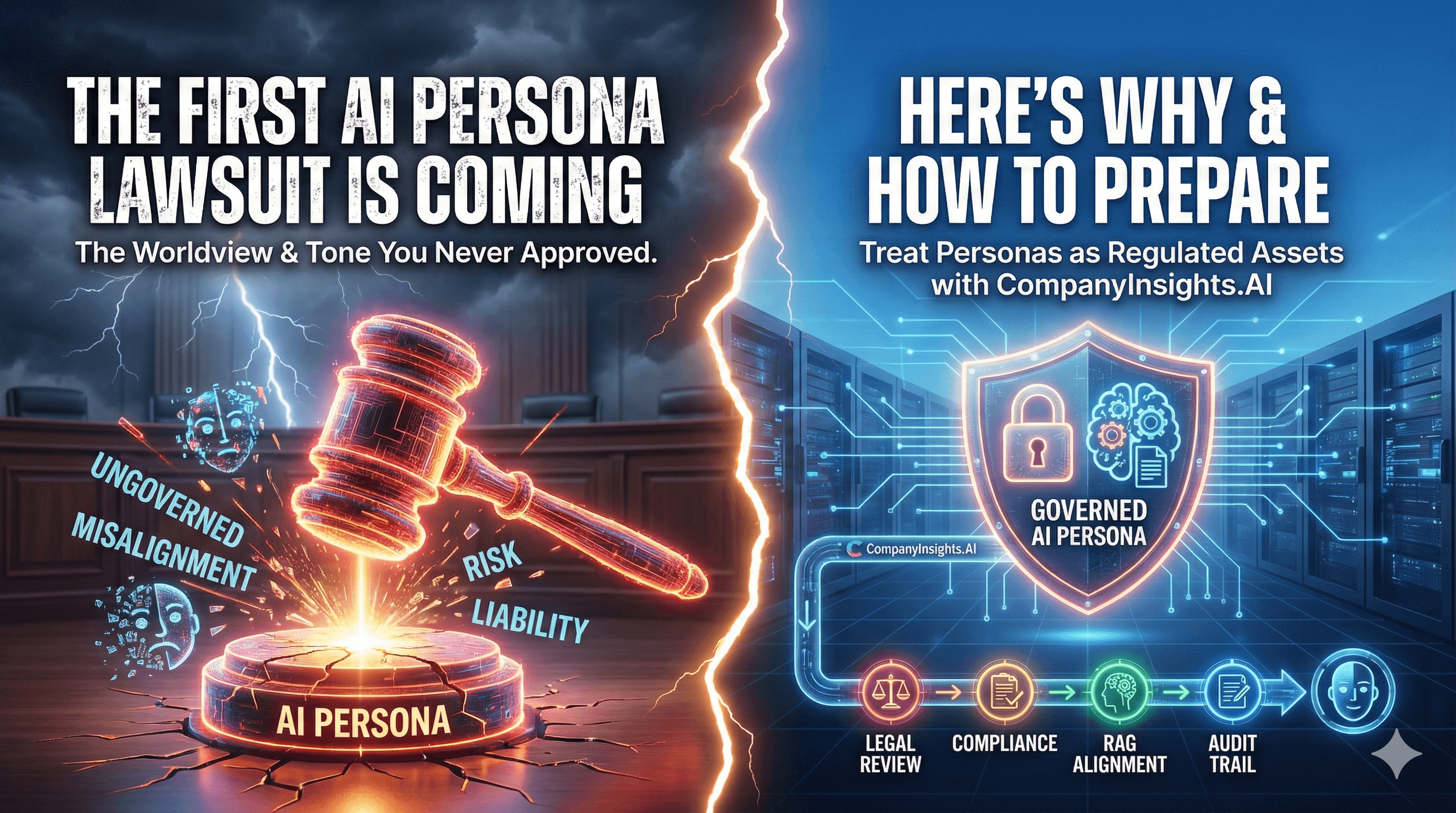
Enterprises are racing to adopt AI. Chatbots are going live. Agents are being deployed. Personas are being written and published into production systems every week.
And almost no one realizes that the next major AI lawsuit will not be about hallucinated facts, copyright, or training data.
It will be about personas.
Not prompts.
Not mistakes.
Not rogue models.
Personas.
The worldview, tone, and intent instructions that shape how an AI speaks.
This is the area of AI governance that almost every organization is overlooking, and it is the one most likely to blow up first.
Let me explain.
AI Personas Now Function as Policy
When an AI answers a customer, patient, employee, or regulator, the persona becomes:
A representation of the company’s beliefs
A signal of how the company interprets its own policies
A proxy for employee training
A guide for how customers should behave
A voice that implies legal or regulatory commitments
In other words:
The persona becomes policy the moment the AI speaks it aloud.
And courts are going to treat it that way.
The Risk No One Is Talking About
Consider the following real-world scenarios:
1. A healthcare AI expresses empathy in a way that implies coverage or financial responsibility.
Regulators view emotional language as a binding customer expectation. The enterprise is liable.
2. A financial services bot uses “helpful” language that softens disclosures.
Compliance officers call this “informal misrepresentation.” Plaintiffs’ attorneys call it “evidence.”
3. A recruiting assistant’s persona uses upbeat, casual phrasing with candidates.
A claim of bias or inconsistency suddenly has ammunition.
4. A political or advocacy organization uses AI that unintentionally moderates or intensifies positions.
That is not a mistake. That is message corruption.
None of these failures come from the model hallucinating a fact. They come from the persona misrepresenting the organization’s worldview.
Courts Will Not Care That It Was “Just AI”
In litigation, three questions matter:
Did the AI say it?
Was the AI speaking as the company?
Would a reasonable person believe the AI reflected the company’s stance?
If the answer is yes, then the persona is treated as corporate speech.
Not a technical artifact.
Not a glitch.
Corporate speech.
That moves personas directly into the domain of:
Legal review
Regulatory scrutiny
Compliance standards
Customer communication policies
This also means plaintiffs will request persona files in discovery. Plaintiffs will ask:
“Who wrote this persona?”
“What instructions were given?”
“What worldview was encoded?”
“Did the company approve this language formally?”
Most organizations will not have answers.
The AI Governance Gap That Creates Liability
There are three dangerous patterns emerging across enterprises:
Pattern 1: Personas written by engineers instead of governance teams
This results in tone, empathy, and positioning that Legal never signed off on.
Pattern 2: Personas that evolve organically with each release
Model updates silently shift tone and worldview. No one notices until after the damage.
Pattern 3: Chatbots trained on the “default” persona that comes with the model
Which means your organization is effectively adopting OpenAI or Google’s worldview, not your own.
This is how lawsuits happen.
Not because of errors.
Because of misalignment.
The First Persona Lawsuit Will Follow a Familiar Pattern
It is likely to look like one of the following:
A benefits miscommunication case.
A persona sounds compassionate and suggests eligibility where none exists.
A financial disclosure inconsistency.
A persona softens the wording of a required statement.
An employment discrimination claim.
A persona uses language that feels dismissive, biased, or inconsistent.
A healthcare communication failure.
A persona adopts a patient-advocate tone instead of a payer tone.
A political messaging misfire.
A persona reframes a candidate’s actual position.
In each scenario, the persona becomes the evidence.
Persona Governance Is No Longer Optional
Enterprises need to treat personas the way they treat any document that defines voice, intent, or boundary:
Internal policies
Legal disclaimers
Training manuals
Brand guidelines
Regulatory statements
This is why at CompanyInsights.AI we build personas the same way enterprises build compliance assets:
Worldview definition
Tone and lexicon controls
Regulatory constraints
Explicit do and don’t language
Alignment with internal documents
Auditable version history
Governance approval paths
This is not “prompt engineering.”
This is organizational risk management.
Here Is the Reality No One Wants to Admit
AI personas are the new regulatory perimeter.
They determine:
What promises your brand makes
What tone your company uses
What empathy is implied
What authority is projected
What worldview is expressed
They are the source of future lawsuits because they replace human speech at scale. And when a persona is wrong, it is wrong thousands of times per day.
In Summary
The first persona lawsuit is coming. It is not a matter of if, only when.
If your AI speaks without a formally defined, governance-approved persona, your organization is exposed.
The fix is clear:
Treat personas as regulated communication assets
Give Legal, Compliance, HR, and Brand ownership
Use Agentic RAG to enforce alignment and prevent drift
Audit and version personas the same way you audit policies
Do not let models decide your worldview for you
If you want help building enterprise-grade personas and persona governance frameworks, I am happy to walk you through how we approach this at CompanyInsights.AI. You can connect with me directly (David Norris) for a free consultation — or even Book a Same Day Demo.
More blog

See CompanyInsights.AI on your data
Schedule a live demo and we’ll show you how Agentic RAG + Personas work with your policies, contracts, and internal docs.